
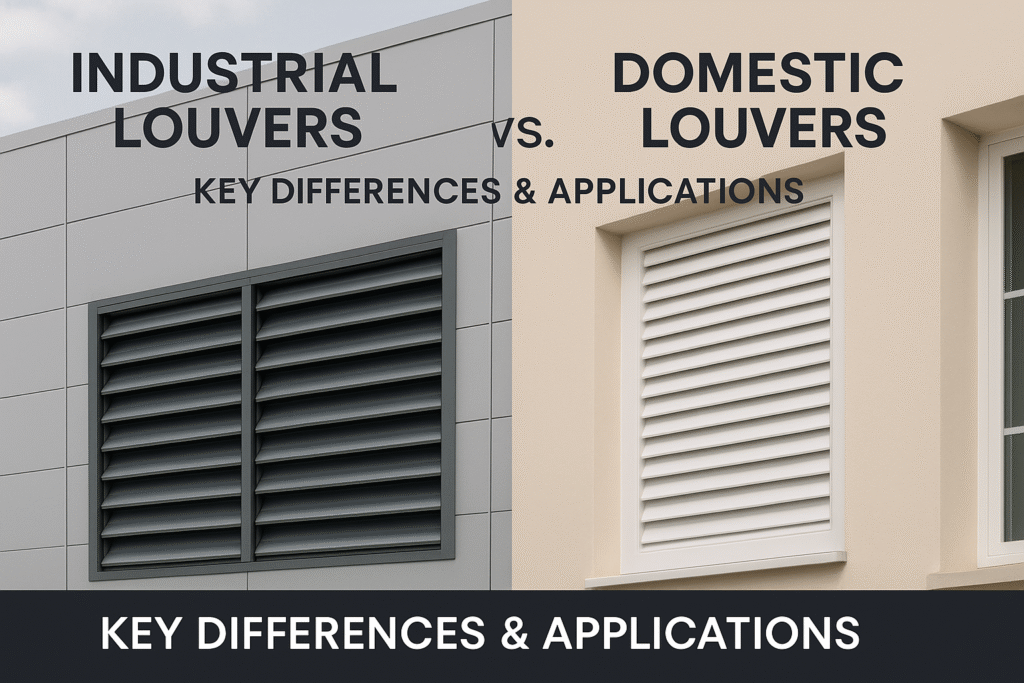
Industrial Louvers vs Domestic Louvers: Key Differences & Applications
Louvers are essential components of modern building design — they manage airflow, control temperature, and protect interiors from rain, dust, and noise. But not all louvers are created equal. The louvers used in industrial environments are vastly different from those designed for residential or commercial buildings.
Understanding these differences helps designers, architects, and builders select the right type of louver for optimal performance, safety, and aesthetics.
At Geometric Steels, we engineer a wide range of metal louvers — from heavy-duty industrial models to sleek architectural variants — each tailored to specific airflow and environmental demands.
The Purpose of Louvers
At their core, louvers regulate the exchange of air between the interior and exterior of a structure. They allow fresh air to enter while blocking rain, dust, insects, and direct sunlight.
However, the environmental conditions and performance expectations differ drastically between industrial and domestic applications — influencing how louvers are designed, constructed, and installed.
1. Structural Strength and Material
Industrial Louvers
- Built for heavy-duty, high-velocity air movement.
- Made from galvanized steel, aluminium, or stainless steel to resist corrosion and withstand pressure differentials.
- Frames and blades are reinforced for mechanical strength.
- Often powder-coated or anodized for enhanced durability.
- Can be large-format, sometimes spanning several meters.
Domestic Louvers
- Primarily used for ventilation in small spaces such as bathrooms, kitchens, attics, and façades.
- Typically made from PVC, lightweight aluminium, or uPVC.
- Focused more on aesthetics and natural ventilation than on airflow performance.
- Compact and decorative in design.
2. Airflow and Performance
Industrial Louvers
- Designed to achieve high free-area ratios for maximum airflow efficiency.
- Must handle large air volumes from machinery exhaust, HVAC ducts, or process ventilation systems.
- Include features like aerodynamic blades, pressure-drop optimization, and sand or water baffles for clean, controlled airflow.
Domestic Louvers
- Facilitate gentle natural ventilation.
- Typically static and not required to meet industrial airflow standards.
- Often include insect screens or decorative frames rather than airflow optimization.
3. Resistance to Environmental Factors
Industrial Louvers
- Operate in harsh conditions — exposure to dust, chemicals, high humidity, or temperature extremes.
- Must maintain performance in challenging environments like factories, boiler rooms, or coastal facilities.
- Many designs, such as Sand Trap Louvers, are engineered to separate dust or rain particles from air streams.
Domestic Louvers
- Exposed mainly to ambient weather and occasional moisture.
- Designed for moderate resistance; corrosion protection is achieved through light coating or anodizing.
- Not suitable for corrosive or high-temperature environments.
4. Design and Aesthetic Role
Industrial Louvers
- Prioritize functionality and ventilation efficiency.
- Blade profiles are deeper and angled to control rain penetration.
- Often integrated into façade cladding or mechanical openings.
- Large-scale, modular systems can still maintain clean architectural lines — especially in powder-coated aluminium finishes.
Domestic Louvers
- Focus heavily on appearance and style.
- Available in designer profiles and colors to complement architectural themes.
- May feature adjustable or decorative blades for aesthetic appeal.
5. Applications
| Application Type | Industrial Louvers | Domestic Louvers |
| Ventilation Purpose | Continuous exhaust or intake in large buildings | Natural airflow in homes or small commercial spaces |
| Installation Location | Factories, warehouses, power plants, data centers | Bathrooms, kitchens, residential façades |
| Airflow Volume | High-volume, continuous operation | Low-volume, intermittent |
| Maintenance Requirement | Periodic cleaning of blades and drainage | Minimal, occasional dust removal |
| Design Focus | Functional performance and durability | Aesthetic integration and privacy |
6. Engineering Precision in Industrial Louvers
Industrial applications require precise airflow calculations, especially in high-temperature or dust-prone environments.
Geometric Steels designs industrial louvers using advanced engineering parameters such as:
- Pressure drop coefficients (to maintain system efficiency)
- Free-area calculations (to ensure optimal air exchange)
- CFD-based airflow modeling (for critical installations)
- Customized drainage paths to prevent water ingress
These design optimizations ensure our louvers meet industrial-grade performance standards while offering architectural versatility.
7. Sustainability and Energy Efficiency
Louvers contribute to passive cooling and natural ventilation, reducing dependency on mechanical HVAC systems.
- Industrial Louvers: When combined with Airflow Ridgevent™ systems, they enhance cross-ventilation, creating a sustainable air exchange cycle.
- Domestic Louvers: Improve indoor air quality by enabling passive airflow, reducing condensation and mold growth.
In both cases, louvers support eco-friendly building design by minimizing energy consumption.
Why Choose Geometric Steels Louvers
Geometric Steels offers a complete range of metal louvers engineered for both industrial and architectural applications:
- Industrial Louvers: Heavy-duty galvanized or aluminium construction, ideal for factories, compressor rooms, and process plants.
- Sand Trap Louvers: Designed for dust filtration in coastal or desert regions.
- Architectural Louvers: Powder-coated aluminium variants for façades and commercial projects.
- Custom Louvers: Tailored to meet airflow, noise, or aesthetic requirements.
Every louver is precision-fabricated for efficiency, durability, and seamless integration with other roofing and ventilation systems.
Industrial or Domestic — The Right Louver for Every Application
While domestic louvers enhance comfort and appearance, industrial louvers deliver performance where it matters most — in demanding, high-temperature, or dust-laden environments.
Choosing the right louver isn’t just about ventilation; it’s about ensuring safety, energy efficiency, and structural balance.
With Geometric Steels Louvers, you get a product that’s engineered for both function and finesse — meeting the highest standards of performance and design.
Contact Us
For technical consultation or customized louver solutions:
📞 +91-85509 95556
📧 roof@geometricsteels.com
🌐 www.geometricsteels.com | https://metalslouver.com/
Keywords: industrial louvers, domestic louvers, metal louvers, ventilation louvers, architectural louvers, sand trap louvers, aluminium louvers, factory ventilation louvers, wall louvers, home ventilation louvers, industrial façade ventilation, passive ventilation system, airflow louvers, custom louvers India, Geometric Steels louvers